Table of Contents
Best Lens for Butterfly Photography
The first time I went out to photograph butterflies, I took a kit zoom and a lot of confidence. I came home with about two hundred pictures of flowers that a butterfly had left a few seconds earlier. The lens wasn’t the only problem, but it was a big one. I couldn’t focus close enough, and when I backed up to get a sharp frame, the butterfly was a tiny speck in the middle of a lot of grass.
So if you are searching for the best lens for butterfly photography, I get it. The choice looks confusing from the outside. Macro or telephoto? 60mm or 200mm? Do you need to spend a month’s salary? Short answer: no, but the lens you pick will change how you shoot, so it is worth thinking through. Here is what I have learned from standing in a lot of wet fields at six in the morning.
What a butterfly lens actually needs to do
Forget brand names for a minute. A good butterfly lens does three jobs.
It lets you fill the frame. Most butterflies are between 4 and 10 centimetres across. To get a frame where the insect is the hero, you need decent magnification. That is why macro lenses are popular. A true macro lens reaches 1:1, meaning the subject is projected on the sensor at life size. If you want the technical background, the Wikipedia entry on macro photography explains reproduction ratios clearly.
It lets you keep your distance. This is the part beginners overlook. Butterflies are skittish. Get too close, throw a shadow on them, and they’re gone. A lens with a long working distance (the space between the front of the lens and the subject) gives you room to breathe.
It focuses fast enough, and accurately enough. At close range your depth of field is razor thin, sometimes a couple of millimetres. If the autofocus hunts, you miss the shot. If you want to understand why this happens, the article on depth of field is a decent read.
Everything else, like image stabilisation, weather sealing and how the lens looks on your camera, is a bonus.
Which focal length is best for butterflies?
If you made me pick one number, I’d say 100mm, give or take. A 90mm to 105mm macro lens gives you 1:1 magnification and a working distance of roughly 30 cm at closest focus. That is enough room that most butterflies don’t spook, and it is short enough that the lens stays light and easy to handhold.
Here is how the common ranges behave in practice:
| Focal length | Working distance at 1:1 (approx.) | Good for | Watch out for |
|---|---|---|---|
| 50–60mm macro | Very short, around 15–20 cm | Calm butterflies, cool mornings, tight budgets | Your shadow and the lens barrel scare them |
| 90–105mm macro | Around 30 cm | The all-rounder for most people | Not much, honestly |
| 150–200mm macro | 45 cm or more | Nervous species, flowers you can’t reach | Heavier, pricier, harder to handhold |
| 70–300mm zoom | 1 to 1.5 m at its closest | Active butterflies, bigger species, mixed wildlife shooting | Never reaches 1:1, so details are smaller |
Those distances vary from lens to lens, so check the spec sheet of whatever you’re considering. But the pattern holds: the longer the lens, the further back you stand.
On a crop-sensor camera (APS-C), you also get extra reach for free. A 100mm lens acts roughly like a 150mm lens in terms of framing. That is one reason a lot of butterfly shooters are perfectly happy with crop bodies.
Macro lens or telephoto zoom?
This is the question I get asked most, so let me be direct.
On my Nikon I use two lenses for butterflies: a telephoto and a dedicated macro. I wrote about that setup in my macro photography tips and techniques post, and both genuinely work. They just work differently.
When the macro lens wins
A macro lens is what you want when you have a butterfly that sits still. Early morning, dew on the wings, body still cold and slow. You can move in, compose carefully, and capture the scales on the wing and the fine hairs on the thorax. Nothing else gives you that level of detail. The same lens also doubles as a flower lens, an insect lens, a product lens and even a decent portrait lens at 100mm.
When a telephoto wins
A telephoto zoom wins in the afternoon. The sun is high, the butterflies are warm and fidgety, and every time you creep forward they flutter off. With a 70-300mm or similar, you can stay five or six feet back and still get a frame that is usable. You won’t get life-size detail, but you’ll get shots you wouldn’t otherwise. Many 70-300mm zooms focus closer than people expect, often reaching something like 1:3 to 1:4, which is plenty for a Plain Tiger or a big Swallowtail.
If you can only buy one lens, and your budget is limited, I’d lean toward the macro. It teaches you fieldcraft, and the images are more distinctive. If you already own a telephoto, use it for a few weeks before buying anything. You might be surprised by what it can do.
Lenses worth looking at
I’m not going to pretend I’ve tested every lens on the market, so treat this as a starting list of well-regarded options rather than a ranking. Prices change constantly, so check current listings.
Nikon
The Nikon 105mm f/2.8 macro (the VR version for F-mount, and the MC 105mm f/2.8 VR S for Z-mount) is the obvious choice at the top. For something cheaper, the 40mm f/2.8 and 85mm f/3.5 DX macro lenses suit crop bodies. I put together a longer rundown in best macro lenses for Nikon cameras if that’s your system.
Canon
The EF 100mm f/2.8L Macro IS USM is a long-time favourite, and its RF-mount sibling does the same job on mirrorless. On a budget, the EF-S 60mm f/2.8 Macro is solid on crop bodies, though you’ll be close to your subject.
Sony
The FE 90mm f/2.8 Macro G OSS is the one most Sony shooters end up recommending. It’s sharp, stabilised, and a comfortable size.
Third-party options
Tamron’s 90mm f/2.8 macro and Sigma’s 105mm f/2.8 macro have been popular for years, and they come in several mounts. Sigma also makes a 150mm f/2.8 macro, which is lovely for skittish subjects if you can live with the weight. Tokina’s 100mm f/2.8 is another one to look at. These often cost noticeably less than the camera-brand equivalents.
Telephoto zooms
Every brand makes a 70-300mm or similar. They aren’t glamorous, but they are cheap, versatile and good enough for plenty of butterfly work, especially if you’re also photographing birds or other wildlife.
Cheaper ways to get close
Maybe a dedicated macro lens isn’t happening this year. That’s fine. There are workable options, and I covered a few in my guide to macro photography on a budget.
- Extension tubes. Hollow spacers that sit between the camera and lens. They have no glass, so they don’t hurt image quality, and they let your existing lens focus closer. I compare them with real macro lenses in extension tubes vs macro lens.
- Close-up filters. Screw-on magnifiers. Cheap and light, though they soften the edges of the frame.
- A used macro lens. Older manual-focus or first-generation autofocus macro lenses often sell for far less than current models, and butterflies don’t care how old your lens is.
- Your phone. Honestly a legitimate starting point. See how to photograph butterflies with a phone.
If you’re also shopping for a body, my posts on budget DSLRs and DSLR cameras for beginners might help you decide where to put your money first.
Lens settings that matter more than the lens
A great lens used badly will lose to an average lens used well. A few habits make the biggest difference.
Don’t shoot wide open all the time. At f/2.8 on a macro lens, you may get only the eye in focus and not the wings. Try f/5.6 to f/8 when the butterfly is posed with its wings parallel to your sensor. You’ll get the whole wing sharp, and the background will still blur nicely.
Match shutter speed to your hand. Even when the butterfly is still, your hands aren’t. As a rough guide, I try to stay above 1/250 second with a 100mm lens, and faster if there’s any wind. Raise ISO instead of accepting a blurry frame. Grain can be cleaned up. Motion blur can’t.
Use the light. Butterflies warm up in the early morning sun, and that is also when the light is softest. I wrote about light and angles in the macro tips article linked above. If you want a feel for how low sun changes a scene, my sunset photography guide covers the same warm, directional light.
Get on their level. Parallel to the wing plane gives you the sharpest result. Shooting down from above is the quickest way to end up with half a butterfly in focus. For more on composition and approach, my complete guide for butterfly photography goes step by step.
The folks at Butterfly Conservation have a short piece of tips for photographing butterflies from a working wildlife photographer, and Nikon’s own top 10 butterfly photo tips are worth a skim too.
Mistakes I see (and made)
Buying too much magnification. Lenses that go beyond 1:1, like the Canon MP-E 65mm, are fascinating but nearly useless for a moving butterfly. They’re for eyes and scales, on tripods.
Ignoring your shadow. You can have the longest lens in the world and still scare a butterfly with a shadow falling across its wings. Approach from the side, or with the sun behind the butterfly.
Chasing. If a butterfly is flying, let it go. Find a flower it likes and wait. Butterflies come back to the same perch surprisingly often.
Forgetting the ethics. Don’t trample habitat for a shot, don’t touch the wings, and don’t move the insect to a prettier flower. The charity’s page on responsible wildlife photography is a good reminder.
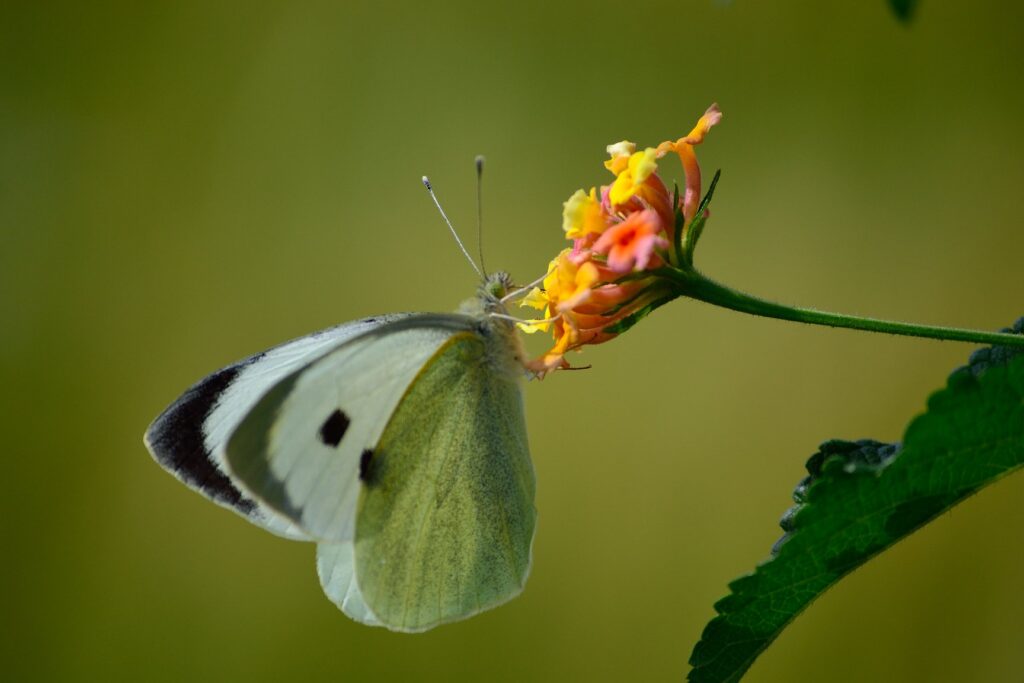
You can see what a macro lens and a bit of patience produce in the photo gallery, and in species posts like the Painted Lady, the Plain Tiger and the Blue Pansy.
FAQ
What is the best lens for butterfly photography for beginners?
A 90mm to 105mm macro lens is the safest pick. If your budget is tight, a 70-300mm zoom you already own, plus a set of extension tubes later, is a sensible way to start.
Is a 100mm macro lens good for butterflies?
Yes. It gives you life-size magnification and enough working distance that most butterflies stay put. It is the lens I’d recommend to most people.
Do I need a macro lens, or is a telephoto enough?
A telephoto is enough for many shots, especially of larger or more active butterflies. A macro lens gives you finer detail on resting ones. Plenty of photographers carry both.
Is image stabilisation worth paying for?
It helps with handheld work, but at high magnification the stabiliser’s benefit shrinks. Good technique, faster shutter speeds and a steady stance matter more.
What about mirrorless versus DSLR?
Both work well. Mirrorless eye and subject tracking can be a real help with insects, but a DSLR with a good macro lens will still produce excellent butterfly pictures.
The short version
Get a macro lens around 100mm if you can. If you can’t, work with a telephoto and some patience, and add extension tubes when you’re ready. Then spend your real effort on early mornings, soft light and quiet approaches. That combination beats expensive glass in a hurry every time.
Browse more in my photography tutorials, or head to the gear section for more lens and camera notes. Questions? Email me, the address is on the about page.
4 thoughts on “Best Lens for Butterfly Photography”